
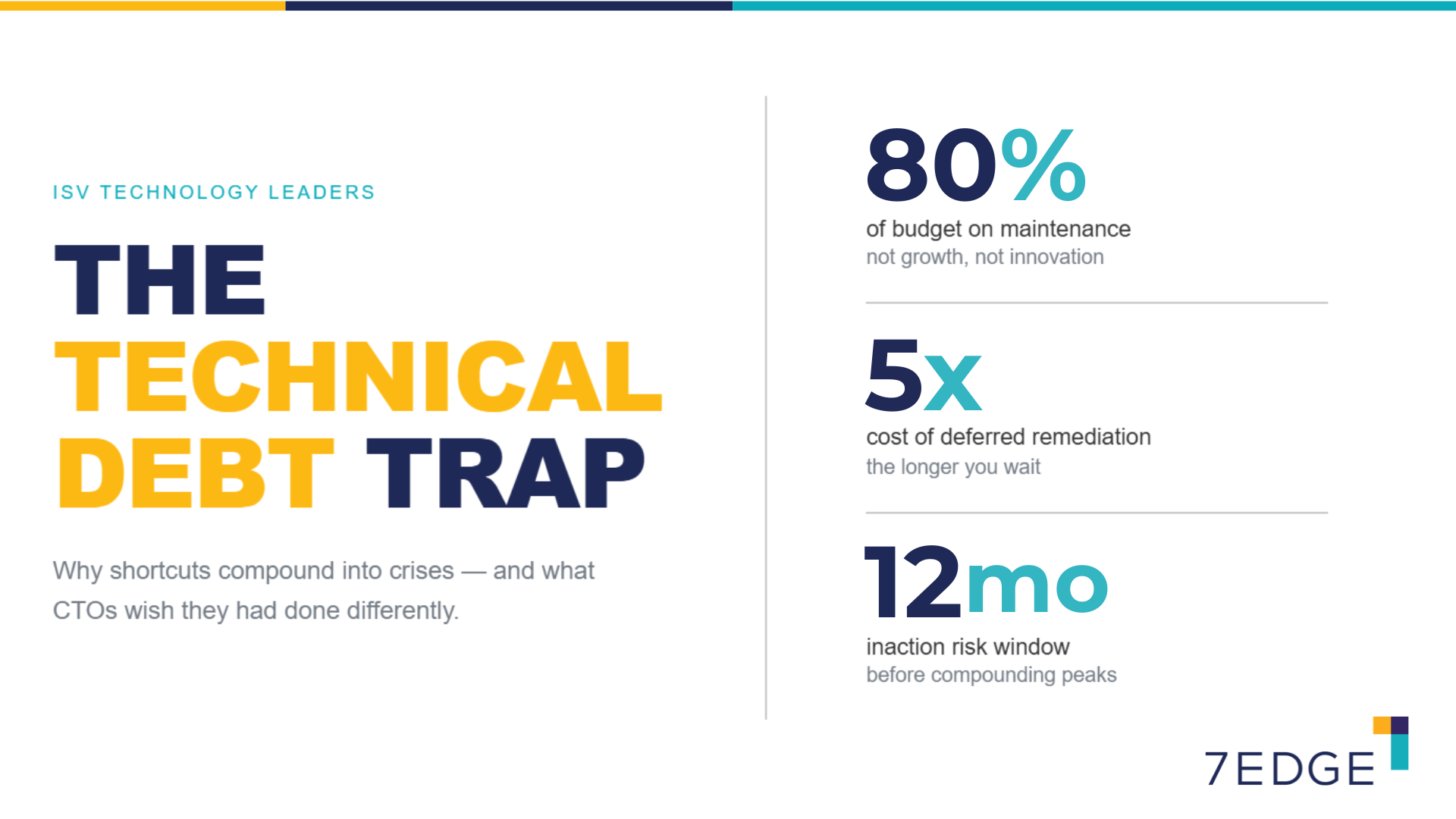
80% of your engineering budget might already be going towards keeping broken systems alive - not building anything new. That's not a technology problem. That's a business emergency with a solvable answer.
Technical debt rarely announces itself. It accumulates quietly, one shortcut, one deferred upgrade, one ‘we’ll fix it later’ decision at a time. But at some point, it later becomes now, and the cost of inaction becomes impossible to ignore. Similar to financial debt, interest will accumulate over time, costing businesses more than they can imagine, simply because they thought taking shortcuts was the better option.
In this article, we’re going to explore technical debt a little more, what ISV CTOs wish they’d known sooner, and look at solutions to help. Keep reading if you would like to find out more.
What Is Technical Debt?
Technical debt occurs when a company has taken shortcuts or taken the ‘easy’, less-than-optimal solution for their business. It’s the accumulation of shortcuts in code, architecture, and infrastructure that make sense in the short term but create serious drag over time. This leads to higher maintenance costs, slower development speed, and also reduced code quality - causing companies problem after problem.
Left unaddressed, technical debt doesn’t stay still; it grows. And eventually, it stops being a technical problem and starts being a business one.
What ISV CTOs Have To Say About Modernisation Regret
Modernising a platform takes real investment, time, money, and organisational will. Unfortunately, there are many companies out there at the moment that haven’t done this and have found themselves in the position of accumulating technical debt as they attempt to get around the hard parts. Companies that have done this have stated their number one regret, and we’re going to give you some of them right now.
- Underestimating the Cost of Waiting: The debt compounds, causing a massive, unmanageable backlog of maintenance, requiring 80% of the budget just to keep existing systems running.
- Misunderstanding the Scope of Technical Debt: Even after upgrading the language or technology, the system remains fragile, fails to scale, or still prohibits the rapid adoption of AI-enabled features.
- The Big Bang Modernization Attempt: Projects become high-risk and low-certainty, often leading to months or years of stalled feature development, which frustrates customers and loses market share.
- Poor Vendor or Tooling Choices (The "Vendor Chaos" Trap): High-priced consultants or automated tools fail to tackle the core business logic issues, leading to significant rework and further debt.
- Ignoring Developer Experience: Experienced developers, who understand the legacy system, leave, resulting in a loss of institutional knowledge and making future modernization even more dangerous.
Using an assessment ensures that you don’t fall into these traps, but instead face the problems head-on. With the features of the assessment, these regrets can be avoided in the future, using the information that you are provided.
How Does the Technical Debt Assessment Help?
The Technical Debt Assessment is designed to give ISV technology leaders a forensic, quantified view of their platform’s technical debt specific enough to act on, and credible enough to take to a board or CFO. The output is a board-ready report covering:
- Where the debt sits
- What is it costing the business today
- What a prioritised remediation path looks like
- What is the risk of inaction over the next 12 months?
Having this data allows companies to make the best possible decisions regarding their technical debt. With this area being so complex, having the correct solution to help high-level individuals make better choices is essential. For example, understanding where the debt is and the amount it’s costing the business ensures there can be no misunderstanding of the scope of debt or the cost of waiting.
Don’t Let Technical Debt Define Your Roadmap
Technical debt is not inevitable, but ignoring it is a choice with consequences. The longer it builds, the more it costs, and the narrower your options become. The businesses that act early are the ones that stay competitive.
If you suspect your platform is carrying more debt than you can see, the Technical Debt Assessment gives you a clear, quantified picture of where you stand, specific enough to act on, credible enough to take to your board. Book your free assessment today.
Originally published , updated May 18 2026


