

To evaluate agentic development platform, it takes more than comparing model benchmarks. You need to see how well it plans end-to-end, calls tools, remembers context, and handles multi-step work in real conditions.
For pharma teams, one more test matters: does it help you understand a system, trace each decision, and make changes without breaking its validated state (the documented, tested condition a GxP system must stay in)?
This blog shows you how to put any platform through that test, which results in how to evaluate agentic development platform step by step:
- Why evaluating agentic development platform is different in pharma
- The 7 criteria to check before you choose
- A ready-to-use scorecard for vendor meetings
- A free change-readiness check for one of your validated systems
Why evaluating an agentic platform is different in pharma
Pharma IT works under four pressures most software teams never face:
- Change control: Every change needs an impact assessment, yet most legacy specs no longer match what runs.
- Data integrity: Out of 85 FDA warning letters to drug makers, 15% cited data integrity, but 60% of those to Indian sites did.
- Accountability: AI output entering a quality system must be approved by a person.
- Continuity: When an engineer or vendor leaves, system knowledge often leaves too

So what should you check before you trust a platform with these systems? An Indian plant, a software vendor, and a missing audit trail
In March 2026, FDA Warning Letter 320-26-57 to Intas Pharmaceuticals found that a QA employee had asked the software vendor to change a completed electronic batch record. The change was never captured in the audit trail or managed through the quality system. The lesson: Every change to a validated system, whether by staff, a vendor, or AI, must trace back to a named, approved decision. |

How to evaluate agentic development platform: 7 criteria checklist
Use these as the questions you take into every vendor demo.
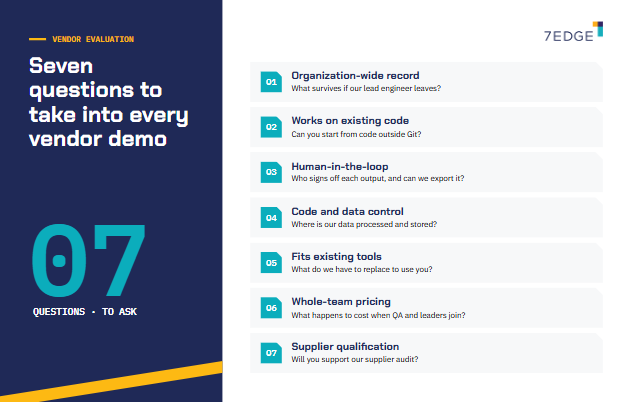
1. It leaves an organisation-wide record when people leave
Knowledge shouldn't live in one developer's session or laptop. The platform should keep a shared record of how the application works. So that IT, QA, and leadership can all have access to the same.
Ask yourself: "If our lead engineer or vendor leaves tomorrow, what do we still have?"
What PHERIX provides: a living record of your application PHERIX stores requirements, design decisions, approvals, and status in Brain, all searchable in plain language. Code documentation stays in your own repository, giving your team a reliable reference even when engineers or vendors leave. So during the next change control, everyone can refer to the same record instead of relying on someone's memory.
|
2. It works on the existing application you already maintain
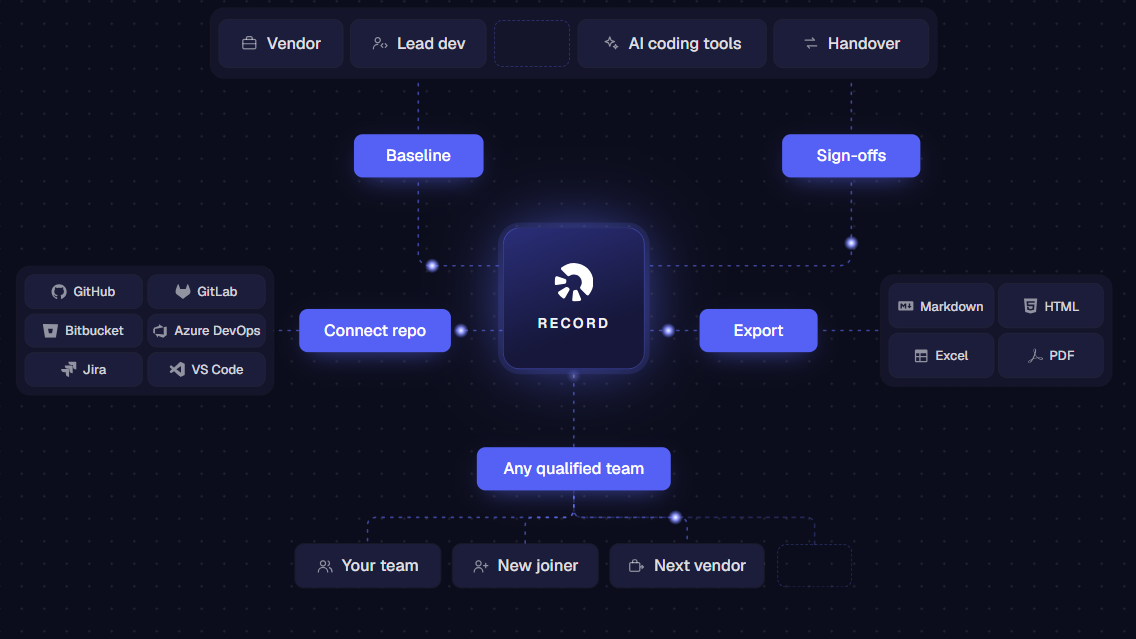
Most pharma IT work changes systems that are already running. The platform should attach to your repository (where code is stored and versioned) and understand it first. Much critical code isn't in Git at all; rather, it is:
- ABAP Z-programs in SAP
- VB6 or Oracle Forms, and
- Database stored procedures.
Ask yourself: "Can you start from our current code, including what lives outside source control?"
3. A person approves every step (HITL)
Human-in-the-loop (HITL) means the AI proposes and a person decides, at every stage. As the Intas case shows, a change with no recorded approval becomes an inspection finding. Your QA head will ask whether each approval is named, time-stamped, and exportable. Here is the “Human-in-the-loop” approval flow
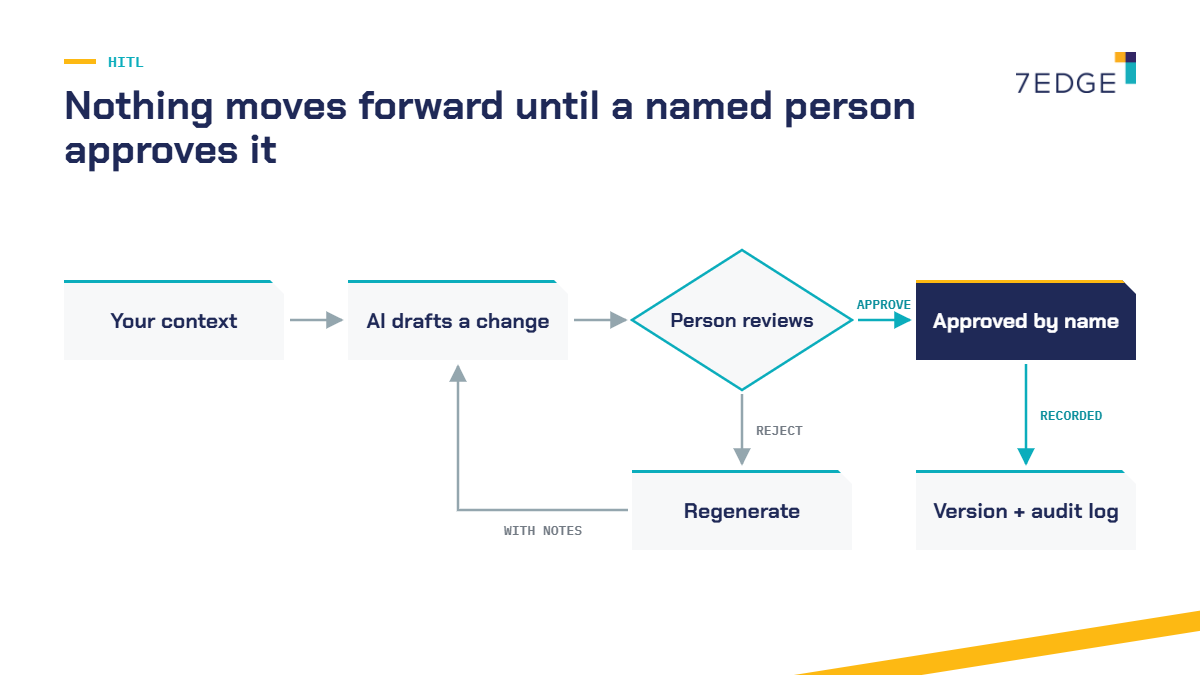
The ask: "Can your platform ever act on its own? Who signs off each output, and can we export that record?"
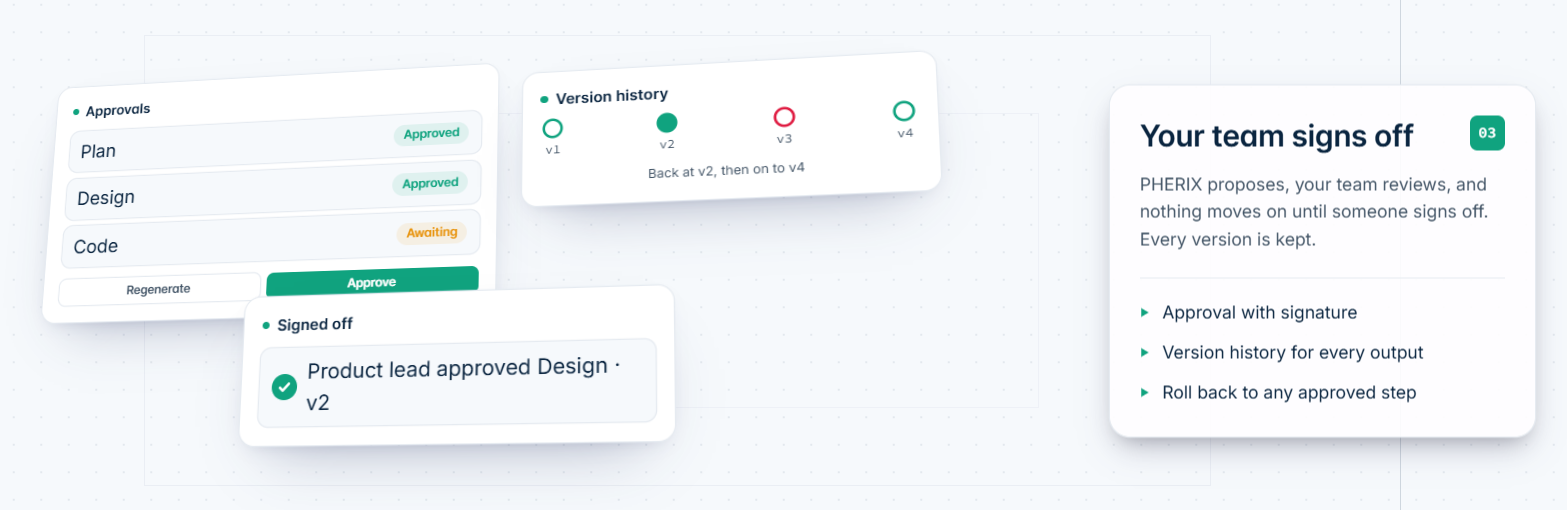
PHERIX: a human in the loop, at every level PHERIX never acts on its own. It drafts from your context, and your people review and approve each stage at key milestones before anything moves forward. Every version is saved, so you can go back if a decision needs another look, and an audit log shows how platform credits are used. Your source code stays with you too: PHERIX stores only the context it needs, never the code itself.
|
4. Your code and data stay under your control
Your IT security team will ask about this first. Check what "context" the vendor stores, where it's hosted, whether an India region or your own cloud account is available, how it fits India's DPDP Act, and which certifications the vendor holds.
The ask: "Do you store our source code? Where exactly is our data processed and stored?"
5. It fits the tools you already use
A new toolchain adds change risk and another system to qualify. The platform should plug into your existing source control, ticketing, CI/CD (the pipeline that automatically builds, tests, and releases code), and cloud.
The ask: "What do we have to replace to use you?"
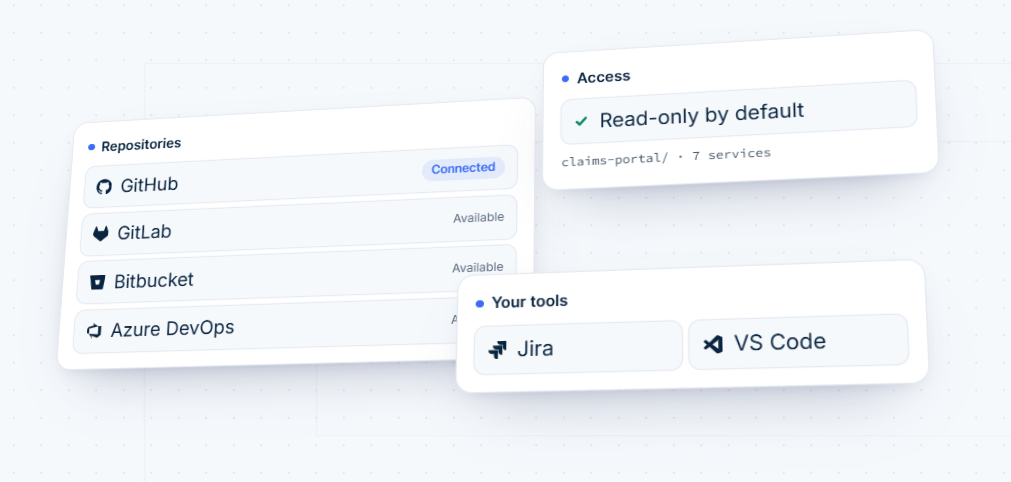
| PHERIX fits how and where you already work. It supports GitHub, Bitbucket, GitLab, Azure DevOps, Jira, a VS Code extension, your CI/CD, any language through PHERIX Rules, and AWS, Azure, or GCP.
|
6. Pricing that lets your whole team in
Per-seat pricing means only developers get licences, leaving out QA, CSV leads, application owners, and leadership. Check what drives the bill, whether usage is visible as it happens, and what a first engagement on one application costs.
The ask: "What happens to our cost when QA, CSV, and leadership need access too?"
PHERIX: No per-seat charges, unlimited users, and credit use visible in an audit log.
Book a demo to know the details of the pricing breakdown.
7. The vendor can pass your supplier qualification
Under CSV (computer system validation, the documented proof that a system works as intended), QA assesses the vendor too, be it:
- Its quality system
- Change management and
- Openness to audit.
A platform QA can't qualify won't get past the pilot.
The ask: "Will you support a supplier audit and share your quality, security, and change-management documentation?"
Agentic development platform scorecard: How PHERIX by 7EDGE measures up
Here's how PHERIX by 7EDGE measures up:
Criterion | Why it matters | How PHERIX meets it |
|---|---|---|
Organization-wide record | Survives staff and vendor turnover | Brain maintains a living, searchable record, while code documentation stays in your repository. |
Works on existing code | Most work changes systems already running | Scans your existing repository and documents its architecture |
Human-in-the-loop | Inspectors expect accountability | Requires approvals at every stage, allows developers to review generated files, and maintains version history. |
Code and data control | Security, DPDP, and GDPR | Stores context rather than source code, keeps each organization's data separate, and has GDPR and SOC 2 compliance in progress. |
Fits into existing tools | Fewer new systems to qualify | Integrates with GitHub, Bitbucket, Azure DevOps, Jira, VS Code, and existing CI/CD workflows |
Pricing for the whole team | QA, CSV and leaders need access | Offers unlimited users with no per-seat fee and a 30-day trial for one application. |
PHERIX by 7EDGE was built around these criteria. It doesn't validate your systems; your CSV and QA teams do. Learn more about PHERIX.
Conclusion
In pharma, speed is worthless if you can't explain, trace, and safely change the result. Choose the agentic development platform that helps you understand your systems first, starting with how ready one of them is for change today.
Before you choose a platform, check your starting point. See if your system can still be explained without the people who built it, then walk through a PHERIX demo built on one of your own applications.
FAQs on evaluate agentic development platform
What is an agentic development platform?
Software that uses AI agents to plan, document, design, and build across the software lifecycle, with people reviewing and approving each stage.
How do you evaluate an agentic development platform?
Check seven things: a shared record, work on existing code, human-in-the-loop, data control, tool fit, whole-team pricing, and supplier qualification.
What does human-in-the-loop mean in AI software development?
The AI proposes, and a person reviews and approves every output before it is used. Nothing is acted on autonomously.
Can agentic AI platforms be used on validated pharma systems?
Yes, as long as people review and approve every output and your CSV and QA teams keep ownership of validation.
Originally published , updated November 27 2026
